While long-term care insurance can be a great way to pay for a nursing home stay or a home health care worker, it doesn't come cheap. Annual premiums vary significantly, depending on your age, health, and the type of policy, but policies can run as high as $5,000 per year. In these challenging economic times, people have to make hard choices on their budget and priorities. Here are some ways to reduce your LTC Insurance costs if you need to take a serious look at your own:
Shorter benefit period. The most significant cost-saving step you can take is to not purchase a lifetime policy. Unless you have a family history of a chronic illness, you aren't likely to need coverage for more than five years. In fact a new study from the American Association of Long-term Care Insurance shows that a three-year benefit policy is sufficient for most people. According to the study of in-force long-term care policies, only 8 percent of people needed coverage for more than three years. By purchasing coverage for three, four, or five years instead of a lifetime, you can save thousands of dollars in premiums. If you do have a history of a chronic disease in your family, you may want to purchase coverage for 10 years, which would still be less than purchasing a lifetime policy.
Buy younger. Long-term care insurance premiums rise as you age, so the younger you buy, the cheaper your premiums. Be careful, however, because insurance premiums can, and often do, increase considerably from your initial purchase price. Even if you have a policy that is "guaranteed renewable," your premiums can still increase.
Shared care policy. If both you and your spouse are purchasing long-term care insurance, a shared care policy might be able to give you more coverage for less money. With a shared care policy, you buy a pool of benefits that you can split between you and your spouse. For example, if you buy a five-year policy, you will have a total of 10 years between you and your spouse. If your spouse uses two years of the policy, you will have eight years. A shared care policy may cost more than separate policies with the same benefit period, but it will allow you to buy a shorter policy, knowing that you have a pool of benefits to work with.
Longer elimination period. Most policies have a waiting period before coverage begins, typically 30-90 days. The longer you make this waiting period, the cheaper your premiums. Keep in mind, however, that you will have to pay for your care out of pocket until the waiting period is over and the insurance begins its coverage.
Reduced daily benefit. Instead of purchasing the maximum daily benefit you might need in a nursing home, you can consider paying for a portion of the daily benefit yourself. You can then insure for the maximum daily benefit minus the amount you plan to pay. A lower daily benefit will mean lower premiums.
Inflation protection. Inflation protection increases the value of your benefit to keep up with inflation and is almost always recommended. But you can save on premiums by which method of protection you choose: compound-interest increases or simple-interest increases. If you are purchasing a long-term care policy and are younger than age 62 or 63, you will need to purchase compound inflation protection. This can, however, more than double your premium. If you purchase a policy after age 62 or 63, some experts believe that simple inflation increases should be enough, and you will save on premium costs.
You should also remember that your premiums may be tax-deductible. Premiums for "qualified" long-term care policies will be treated as a medical expense and will be deductible to the extent that they, along with other unreimbursed medical expenses (including "Medigap" insurance premiums), exceed 7.5 percent of the insured's adjusted gross income.

Catch a glimpse of author Kate McGahan's writings through this blog which features excerpts from her books, poetry over the years, and responses to various events, current at the time of the writing.
Sunday
Memories of California -It Wasn't All Bad
 I'm looking back on our California experience. We have recovered, are moving forward again, and realize what a necessary part it was of our life.
 Typical Ranch View
 Ranch Bedroom
 Ranch yard


View from my ranch bedroom
What an amazing journey. It was a beautiful place.
 Sycamore Canyon Rd -- I traveled this road every day to get to the highway to get to work
 Ranch Resident
 The Ranch where I lived


 Entrance to Ranch

My favorite part of the Ranch driveway
 Jack and I on a hike
 Hiking high above Walnut Creek

What an amazing journey. It was a beautiful place.
 Sycamore Canyon Rd -- I traveled this road every day to get to the highway to get to work
 Ranch Resident
 The Ranch where I lived


 Entrance to Ranch
My favorite part of the Ranch driveway
 Jack and I on a hike
 Hiking high above Walnut Creek


Tuesday
Are You Caught in the Caregiving Web?

There are 22 million family caregivers to the elderly in the US. The majority of them are also employed full-time. 5% of them have taken an unpaid leave of absence; 50% have lost time out of work to fulfill their responsibilities.
-National Caregiving Association
Monday
Welcome
Greetings and welcome to the first entry in our elderplanning blog! The purpose of this site is to post up-to-date information on eldercare and elderplanning so that you can have the information you need at your fingertips when you need it. This blog will also allow us to process information directly rather than pestering our webhost who takes care of our Elderplanning website. Of course we just set up this account this evening and wish that we could have everything on display for you pronto - but it will take time. But we are going to do our best to cover lots of bases here --- medical, emotional, financial and otherwise, so please come back again! We've been in business over a decade and I've personally been in the industry for 25 years --- it will take some time to document here what's in my head. But I'll try -- and I'll do it on a regular basis too. So please stay tuned..... Of course if you can't wait and have an issue that is pressing NOW, don't hesitate to contact our office. Please visit our website for contact information.
Wednesday
40 Days and Nights in The Bay Area

OK -- We tried! We changed our life for a job in Walnut Creek California. We packed our car drove the 13 hours on Halloween Day which was also my birthday. She started work on November 2. Six weeks later we have packed our bags and returned to Sedona. The job wasn't bad -- but working hard 50+ hours per week and not clearing $900/week didn't cut it. The taxes in California are killers! 9%+ on just about everything.
The room we rented was on a 22 acre horse ranch which was spectacular -- but on the second week our room was ransacked by our four-legged roommate. We started looking for another place to live. Meanwhile in the six weeks we were there she suffered a terrible head cold, tonsillitis, 1/2 dozen migraine headaches, daily intestinal distress -- and that was just the beginning. We even did a home visit to a client in Oakland and our car was vandalized while we were in the lady's house. That was about the last straw.
By the time we got home to Sedona, she had lost nine pounds and I had lost 11! It was an example of living in a place that didn't support us. We were running into the wind, swimming upstream in everything we did. Nothing was easy. The mountain ranges were gorgeous and the weather was beautiful, but life in California can be tough. Eight lane highways, overpassing eight lane highways and a rush hour that lasted most of the day and through the weekend too. The company she worked for was excellent, however there were many disappointments. She was told some things up front that did not come to be true. So it was not just one thing that pushed us out of California, but the overall life situation.
Her landscape photos are posted on Facebook. I mostly wanted to post the photos of the place we were living. She "feng shui-ed" it and that was the best part of our stay : )
Her landscape photos are posted on Facebook. I mostly wanted to post the photos of the place we were living. She "feng shui-ed" it and that was the best part of our stay : )
Scroll down further to see photos of me and our ransacked room!
Our Bedroom - BEFORE

Our Bedroom - AFTER
 "Design on a Dime"
(COST: Futon/Craigslist $200 Lamp/Shade/GoodWill $3.99 Bedside Tables/GoodWill $8.98 Velvet Drapes/Marshalls $12.00 Sheers/Hospice Thrift Shop $6.00 Leaf Canvas/GoodWill $3.99)
Livingroom - BEFORE

Livingroom - AFTER
 Cost $0
BEFORE

(that was me and him "before" our episode)
AFTER
 (Cost $0)
Diningroom - BEFORE

Diningroom - AFTER

(Cost: $9 for silk ficus tree at GoodWill)
DEFINITE FENG SHUI DON'TS:

Really BAD Feng Shui --Here's our First Impression of a Most Non-Nourishing Kitchen

It is not just bad Feng Shui -- it is toxic! It was a toxic environment in most ways.
Our roommate was adorable, delightful, bright and witty.
And she lived in a cluttered mess!
We didn't feng shui her private space. We didn't go in there. We left 'well enough" alone.


 How did she sleep in this BED this way? But she did somehow!
CANINE RELATIONSHIP BUILDING:

Getting to know you....

She was never sure if we were playing or fighting. It was a fine line as he and I were learning to live together. He wanted to dominate and you can't blame him. He lived there before I moved in. I never wanted to make a problem and I tried to stay sweet and friendly. I couldn't help it, though, when we played I would always "win, pinning him to the floor on his back beneath my smiling playful face.
It just made him mad over time, I guess.
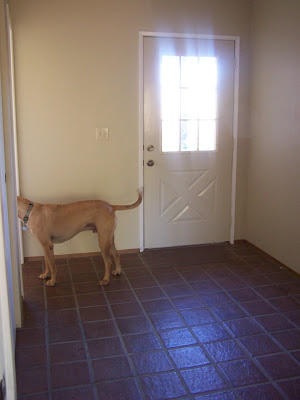
But one day both Kate and the lady went to work and us two dogs were left alone together.
When she arrived home later that night, this is what she found:
A RANSACKED ROOM!
 The bed had been made and the room was spotless when she left that morning. And this is silly, but she actually made the bed before she took this picture (second nature!)
"Somebody" had drawn back all the sheets down to the mattress and had eaten cardboard in our bed! Little grey pieces of cardboard -- I still don't know what that was.

"I didn't do it!"Our stuff was strewn all through the house -- this was the livingroom.
Can you believe he ate the HANGER! And our flashlight too!


I still have the big scab to prove it. We knew we had to leave and while we earnestly sought a new place to live in California, it was not long before we knew we had to leave this place altogether.
 "What on Earth are we doing here?"
 This is how I ask permission to come up on the bed with you. Now I ask
"Can we just go HOME? Please?"
 "Oh God help me."

Tuesday
More California Memories
This was the last turn on the road home from work.

Windy roads for about three miles.
Sometimes we would stop at the Reservoir and walk up up up to the top.
It was worth it for the great views!
Cattle look like ants when you are high enough over them.
Subscribe to:
Posts (Atom)
Popular Posts
-
 Letting Go doesn't mean you don't love them anymore. Letting Go doesn't mean you won't miss them anymore. You'll always...
-
 "I am Don Quixote!... When Destiny Calls Me, Onward I Go!" My first trip to Sedona was in April of 2001. I had just ended a ...
-
 The physical pain may leave but the emotional injury never quite goes away. She thought this was going to be fun.....! His...